
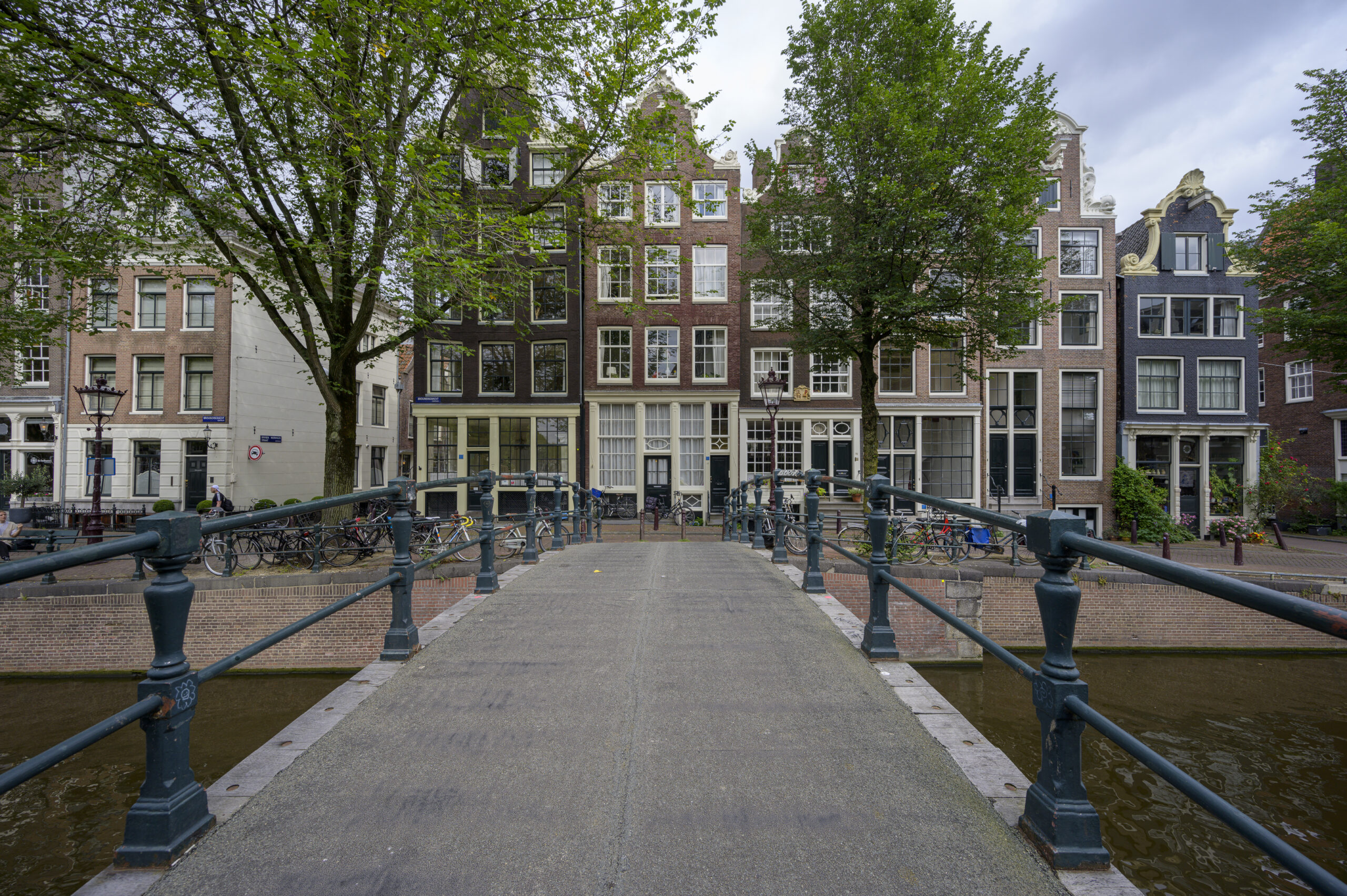
An Amsterdam canal. A bridge over the water. Townhouses beneath a Dutch sky. You look at the photograph and see a peaceful city scene.
What you don’t see is the search that came before it. The bike rides through the city, the attention to the light, and the choices that determine what ends up inside the frame. Yet all of that is part of the photograph too.
In this post, I take you to the other side of the camera.
A familiar place keeps changing
I was born and raised in Amsterdam. Its canals, bridges and streets are familiar to me. Yet it is often in places I know well that I discover something new.
The position of the sun changes the appearance of a building’s façade. Clouds give the water a different colour. A reflection can appear for a moment, then disappear as soon as the water moves.
That is why, for me, a photogenic location is never entirely “finished”. Even when I have photographed it before, there is always a reason to look again. The buildings stay in the same place, but the image is different every time.
For years, I cycled through Amsterdam several times a week, looking for beautiful light and special moments. That familiarity with the city helps me notice small changes.
Choosing what stays outside the frame
When you think about photography, it is natural to focus on what is in the picture. But what you leave out matters just as much.
A small change in viewpoint can make a busy scene feel calmer. A bridge can lead the eye to the other side. A row of townhouses can form a rhythm that only becomes apparent when you shift the frame slightly.
In my photography, I look for calm, clear lines and strong contrasts. That means making choices. Not every detail needs to be included, however interesting it may be on its own.
What I ultimately want to show needs room to breathe.
An unusually quiet Amsterdam
During the pandemic, I had the rare opportunity to photograph an almost empty Amsterdam.
The city I knew so well felt different. Without the usual crowds, the shapes of bridges, the lines of the quays and the proportions of the buildings stood out more clearly.
Looking at one of those photographs today, you might simply see an atmospheric city scene. For me, it also holds the memory of that extraordinary period. That personal story is not immediately visible, but it remains connected to the image.
A photograph sometimes preserves more than you can see at first glance.
From the city to nature
These days, I also spend a lot of time photographing in and around Noordwijkerhout: in the Amsterdamse Waterleidingduinen nature reserve, along the coast and among the flower fields.
The surroundings are very different from Amsterdam, but I bring the same way of looking with me. Here too, I pay attention to lines, light and the relationship between the subject and the background.
In the city, a reflection might catch my attention. In nature, it might be an animal looking up for a moment, or a flower touched by the morning light.
It always begins with paying attention. First I look; only then do I reach for the camera.
What I hope you do see
You don’t need to know the whole story behind a photograph to enjoy it. An image can simply be beautiful. It can bring calm to your living room, stir a memory or let your mind wander to a familiar place.
But perhaps, after reading this, you will look a little longer.
At the light on a façade. At the space around a subject. At the lines that guide your eye through the photograph.
For me, that is a large part of the pleasure of photography: noticing something you might otherwise walk past — and then being able to share it with others.
Curious to see the city through my eyes? Explore my photographs of Amsterdam’s canals.
Leave a Reply