
Photographing the Magere Brug — my 6 best tips for iconic Amsterdam photos
The Magere Brug may be Amsterdam’s most iconic bridge. Thousands of visitors photograph it every year, yet few images capture the true atmosphere of this special place. The difference often lies in the light, composition and, above all, patience rather than the camera.
As a native of Amsterdam, I have been visiting the Magere Brug for years. With my Nikon Z8 and favourite NIKKOR Z 14-30mm f/4 S and NIKKOR Z 24-120mm f/4 S lenses, I have photographed it in every season. From misty winter mornings to balmy summer evenings, when hundreds of lights reflect in the Amstel, each lighting situation tells a different story. Here are my favourite tips.
1. Choose the right time
You rarely take the most beautiful photographs in the middle of the day. My favourite time is undoubtedly the blue hour, roughly twenty to thirty minutes after sunset. The sky still has a deep blue colour, while the Magere Brug’s lights are already on. This contrast creates the romantic atmosphere for which the bridge is so well known.
Early morning is beautiful too, especially with little wind, when the Amstel becomes a mirror reflecting the bridge perfectly.
2. Look beyond the bridge itself
Many photographers stand directly in front of the bridge and take the same photograph as thousands of others. Try a different viewpoint.
Walk along the Amstel and use houseboats, trees or the quay as your foreground. This adds depth and gives the photograph a much stronger story. Reflections in the water can also make the difference between a pleasant photograph and an image that stays with you.
3. Use a tripod
For evening and night photography, a sturdy tripod is virtually essential. It allows you to use a low ISO setting while keeping both the bridge and the historic façades along the Amstel sharp.
When conditions allow, I prefer to shoot at ISO 64. Combined with an aperture of f/8 to f/11, this gives maximum sharpness and beautiful detail. The longer shutter speed also creates calm reflections and an atmospheric rendering of the water.
4. My favourite equipment
I use a Nikon Z8 for my photography. Its high resolution makes my photographs particularly suitable for large wall art prints without losing detail.
My favourite lenses for the Magere Brug are the NIKKOR Z 14-30mm f/4 S and NIKKOR Z 24-120mm f/4 S.
I use the 14-30mm for panoramic cityscapes that bring the Magere Brug, the Amstel and the surrounding canals together in one atmospheric scene. The wide angle beautifully includes the surroundings without an exaggerated perspective.
The 24-120mm is my most-used lens when walking through Amsterdam. It captures both the whole bridge and intimate details of the wooden structure, lighting and reflections. This versatility is ideal for a location where the light is constantly changing.
5. There is really no such thing as bad weather
Many people wait for a clear blue sky, but mist, rain and heavy clouds often create the most atmospheric photographs.
After a shower, the lights reflect beautifully on the wet quays, while on misty mornings the Magere Brug takes on an almost fairytale appearance. These are exactly the moments I like to return for.
6. Take your time
Perhaps the most important tip: be patient.
Sometimes I wait twenty minutes for a boat to reach just the right position, the sky to gain a little more colour or the lighting to look its best. Good photography is about more than technique: it is about observing and waiting for the right moment.
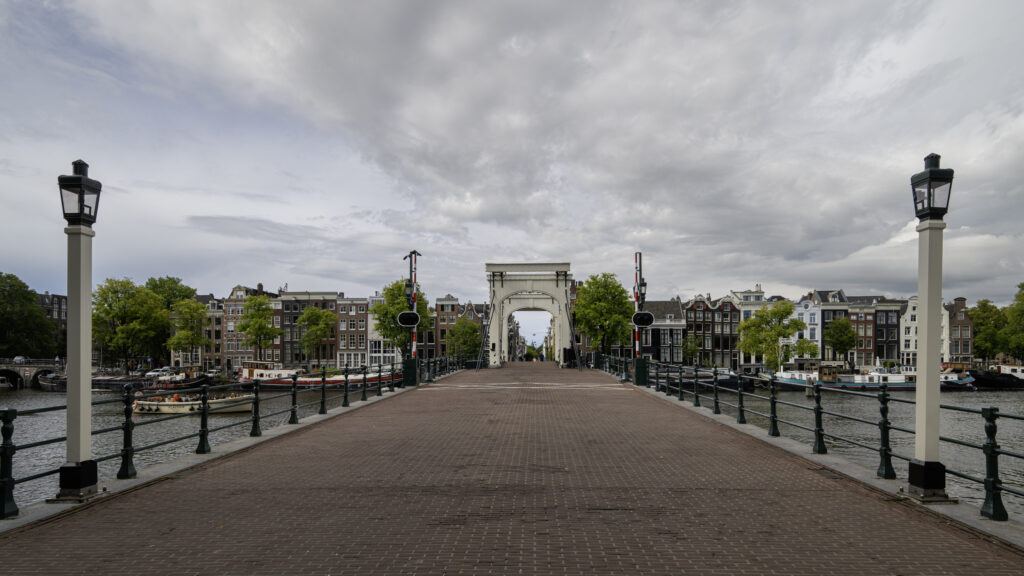
Looking for a special photograph of the Magere Brug for your wall? Explore my complete collection of atmospheric images of this iconic Amsterdam bridge. From colourful sunsets and misty mornings to romantic evening views full of sparkling reflections in the Amstel.
I have personally taken every photograph. They are available in museum quality on canvas, aluminium Dibond, acrylic glass, ArtFrame, framed posters or wallpaper.
Would you like to use one of these iconic canal images on your own website? You can buy licensed photographs of Amsterdam’s canals here.