

The Square Where Amsterdam Began
Few places in Europe have shaped the history of a city as profoundly as Dam Square. Around 1270, a dam was built across the River Amstel to control the water and connect the two riverbanks. This simple engineering project gave Amsterdam its name and created a marketplace that quickly became the city’s commercial centre.
As Amsterdam prospered, the square evolved into the political, religious and social heart of the city. The Nieuwe Kerk rose on one side, while the magnificent City Hall — now the Royal Palace — was built opposite during the Dutch Golden Age. More than seven centuries later, Dam Square remains the stage where Amsterdam’s past and present meet every day.

The Royal Palace – From City Hall to Royal Residence
The copper dome of the Royal Palace has dominated Amsterdam’s skyline since the seventeenth century. Seen from the roof of the Nieuwe Kerk, the close relationship between these two historic landmarks becomes immediately clear. For centuries they have stood opposite each other on Dam Square, connected not only by architecture, but also by the royal ceremonies that continue to shape Dutch history.
Originally built as Amsterdam’s City Hall between 1648 and 1665, the building reflected the wealth and confidence of the Dutch Golden Age. Designed by architect Jacob van Campen, it was considered one of Europe’s finest civic buildings. When Napoleon Bonaparte made Amsterdam the capital of the Kingdom of Holland in 1808, his brother Louis Bonaparte transformed the City Hall into a royal palace. Today, it remains one of the three official palaces of the Dutch Royal House.

Behind its classical façade lies the impressive Citizens’ Hall, where marble maps of the world symbolise Amsterdam’s global trading ambitions during the seventeenth century. Although the palace is open to visitors for much of the year, it still serves as the official setting for state visits, royal receptions and important national events.

The Nieuwe Kerk – More Than Six Centuries of History
Long before the Royal Palace was built, the Nieuwe Kerk already stood beside Dam Square. Construction began around 1380, when Amsterdam had grown so rapidly that the Oude Kerk could no longer accommodate the expanding population. Over the following decades, the church developed into one of the city’s most important religious buildings, standing at the very heart of medieval Amsterdam.
Although no longer used as a parish church, the Nieuwe Kerk remains one of the Netherlands’ most significant historic landmarks. Its Gothic architecture, impressive interior and remarkable history continue to attract visitors from around the world.

The Largest Historic Church Organ in the Netherlands
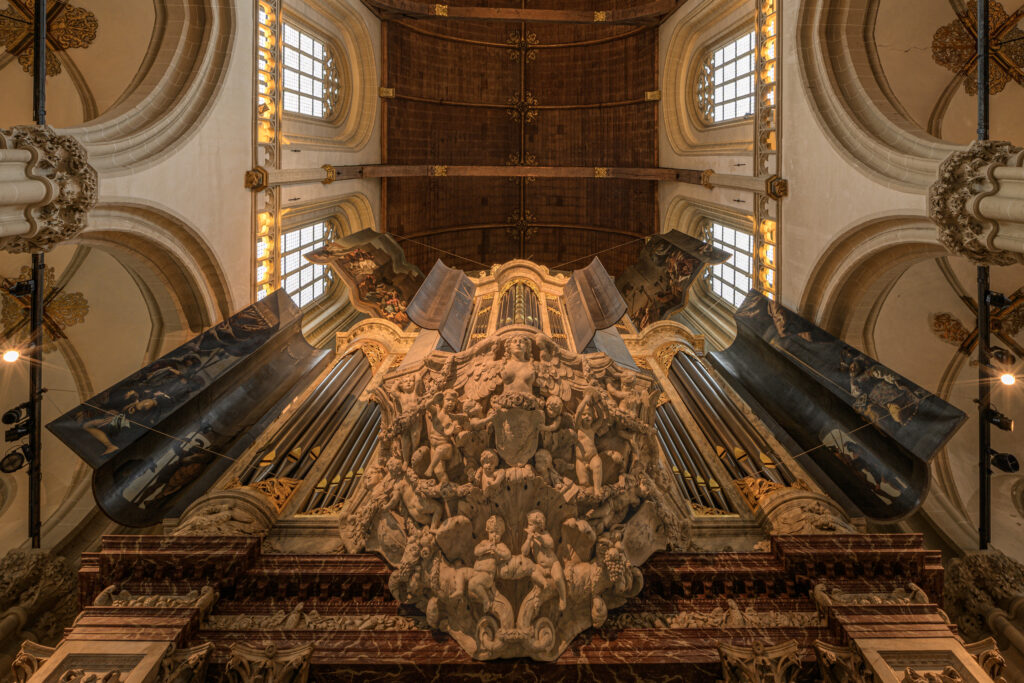
Towering high above the nave, the magnificent organ of the Nieuwe Kerk is one of the finest examples of Dutch Baroque craftsmanship. Built after the great fire of 1645, it has accompanied royal ceremonies, memorial services and concerts for centuries. Today, it remains the largest historic church organ in the Netherlands, filling the Gothic interior with a sound that continues a musical tradition spanning more than 350 years.
For more than six centuries, the Nieuwe Kerk has witnessed many defining moments in Dutch history. Since 1814, it has been the traditional location for the inauguration of Dutch monarchs. Royal weddings have also taken place here, including the marriage of King Willem-Alexander and Queen Máxima in 2002. On these occasions, the Royal Family walks across Dam Square from the Royal Palace to the church, linking the two monuments in a ceremony that has become part of the nation’s identity.

A Square of National Significance
From high above the rooftops of Amsterdam, the true scale of Dam Square becomes clear. For more than 750 years, this has been the city’s symbolic heart, where history, remembrance and daily life come together in one remarkable place.
At the centre of the square stands the National Monument, unveiled in 1956 to honour the victims of the Second World War. Every year on 4 May, thousands gather here for the National Remembrance Ceremony, when two minutes of silence are observed throughout the Netherlands. Just one day later, on 5 May, the atmosphere changes completely as the country celebrates Liberation Day.
Seen from above, the square also reveals its everyday character. Visitors cross the open space, street performers entertain the crowds and locals pass through on foot or by bicycle. Surrounded by the Royal Palace, the Nieuwe Kerk and centuries of history, Dam Square continues to be one of Amsterdam’s most recognisable and meaningful public spaces.

The Spirit of Dam Square
Dam Square has always been far more than a collection of historic buildings. It is a place where Amsterdam comes together. Residents cross the square on their daily routines, visitors pause to admire the Royal Palace and the Nieuwe Kerk, while street performers, musicians and artists create an atmosphere that is never quite the same twice.
The square’s famous pigeons have become part of its identity for generations. Children chase them across the cobblestones, photographers wait for the perfect moment as a flock suddenly takes flight, and visitors instinctively stop to take in the scene. It is these everyday moments that give Dam Square its unmistakable character.
Whether you visit during the quiet hours of an early morning, on a lively summer afternoon or beneath dramatic Dutch skies, Dam Square never loses its unique appeal. It remains the place where Amsterdam’s rich history meets the energy of the city today.

Continue Exploring Dam Square
Whether you visit Dam Square for its history, its architecture or simply to experience the atmosphere, every moment reveals a different side of Amsterdam. From the first light of morning to the bustle of the afternoon and the calm after sunset, the square never looks quite the same twice.
Discover the complete Dam Square photography collection and explore these iconic landmarks through fine art photography.
What to See Nearby
Dam Square sits at the very heart of Amsterdam, making it the ideal starting point for exploring the city’s historic centre. Within just a few minutes’ walk, you’ll discover picturesque canals, medieval streets, lively shopping areas and some of Amsterdam’s most photographed landmarks. Every direction offers a different perspective on the city and countless opportunities for memorable photographs.
Nearby highlights:
- Red Light District – Amsterdam’s oldest neighbourhood, where medieval streets reveal the city’s earliest history.
- Central Station – The historic gateway to Amsterdam, designed by architect Pierre Cuypers and completed in 1889.
- Singel – Amsterdam’s oldest canal, lined with historic houses, bridges and the famous Flower Market.
- Jordaan – A charming district of narrow streets, hidden courtyards and traditional brown cafés.
- Brouwersgracht – Often called Amsterdam’s most beautiful canal, famous for its historic warehouses and picturesque bridges.
- Kalverstraat & Rokin – The city’s main shopping streets, connecting Dam Square with the floating Flower Market and Muntplein.