
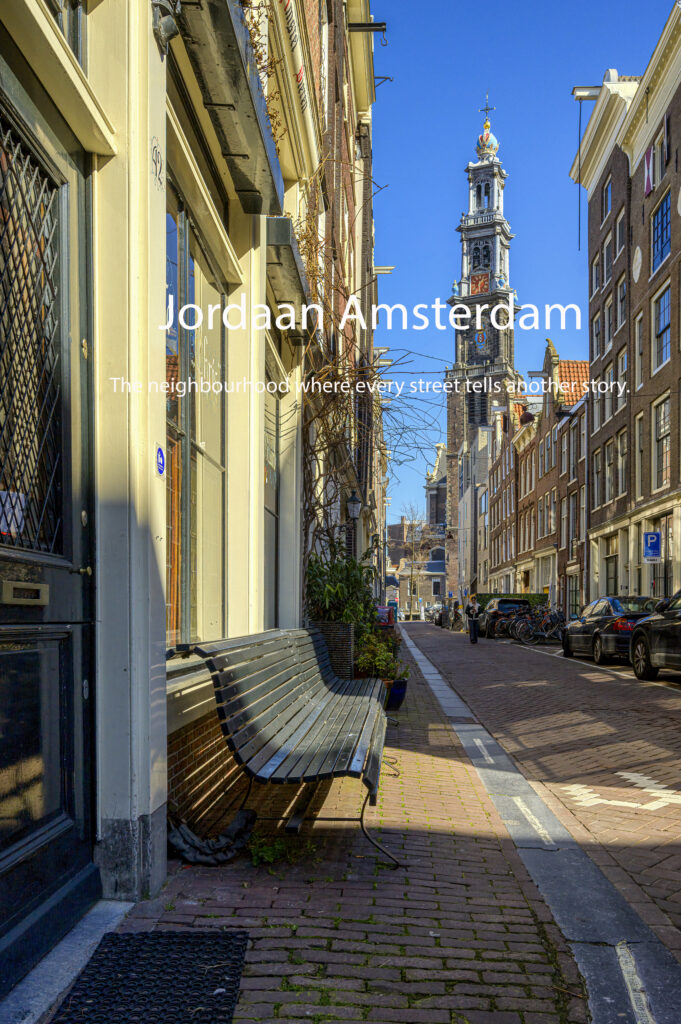
THE JORDAAN: A Neighbourhood Built Around the Westerkerk
The Jordaan was created in the early 17th century as a working-class neighbourhood, built just outside Amsterdam’s expanding canal belt. While the grand merchants settled along the Herengracht and Keizersgracht, craftsmen, labourers and small traders made the Jordaan their home. Towering above the narrow streets stood the Westerkerk, completed in 1631. For nearly four centuries, its tower has remained the district’s unmistakable landmark, guiding residents and visitors alike through the maze of streets.
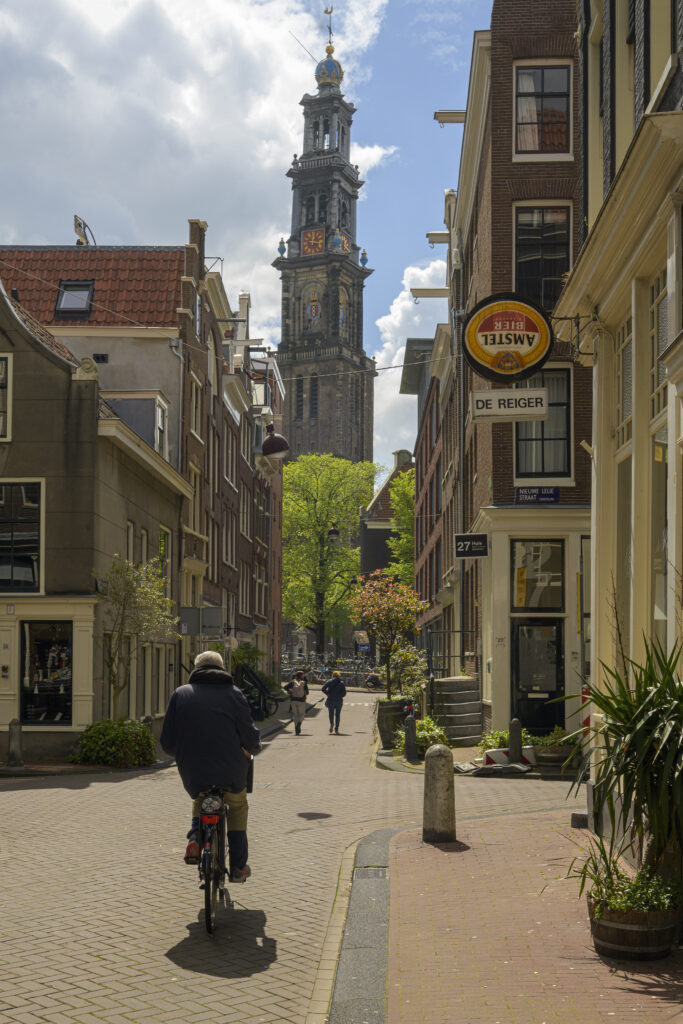
From almost every corner of the Jordaan, the Westertoren suddenly appears between the historic houses. Sometimes it dominates the skyline, sometimes only the upper part of the tower becomes visible. These unexpected views are one of the reasons photographers and visitors keep returning to this neighbourhood.

CAFÉ CHRIS: A TRADITION THAT LIVES ON
Hidden away in one of the Jordaan’s narrow streets stands Café Chris, one of Amsterdam’s oldest traditional brown cafés. Local tradition says that many of the craftsmen who worked on the construction of the Westerkerk gathered here after a long day’s work. Whether every detail of that story can still be verified or not, the café has remained closely connected with the history and character of the neighbourhood for centuries.
Today, Café Chris still feels like the Jordaan of old. There is no grand entrance or fashionable design, just a welcoming atmosphere where locals and visitors meet over a drink. Places like this remind you that the Jordaan has never been defined by monuments alone, but by the everyday life that unfolded around them.

LOOK UP WHEN YOU PASS CAFÉ DE REIGER
Most visitors walk past Café De Reiger without noticing one of its most charming details. One detail immediately catches the eye. The traditional Amstel Beer sign appears upside down, something that surprises many first-time visitors. It has become one of those small curiosities that photographers and observant walkers remember long after they leave the Jordaan.
Like so many places in the Jordaan, Café De Reiger combines centuries of history with everyday Amsterdam life. Details such as its distinctive sign, narrow streets and intimate scale are easy to miss, but together they create the atmosphere that makes this neighbourhood so memorable.

THE BEST WAY TO EXPERIENCE THE JORDAAN
The Jordaan is a neighbourhood best explored without a fixed plan. Walking allows you to discover hidden courtyards and quiet canals, but cycling lets you experience how naturally the district connects with the rest of Amsterdam. Within a few minutes, you can move from lively café terraces to peaceful canal streets and suddenly find yourself looking up at the Westerkerk once again.
Many of the photographs in this collection were created exactly this way: following the light, turning into an inviting side street and simply seeing where the Jordaan would lead next. That sense of discovery is what keeps drawing me back to this neighbourhood.
Continue Exploring Amsterdam
If the Jordaan has inspired you, discover three other places that complete the story of Amsterdam’s historic centre. Every walk through the Jordaan reveals something different. These nearby locations continue the story and offer new perspectives on Amsterdam’s historic centre.
- Discover the Westerkerk Signature Guide – Discover the tower that has watched over the Jordaan for almost four centuries and continues to define its skyline.
- Discover the Prinsengracht Signature Guide – Follow the canal that borders the Jordaan and discover the elegant side of Amsterdam’s Golden Age.
- Discover the Brouwersgracht Signature Guide – Experience the peaceful warehouses, bridges and reflections of the canal many consider Amsterdam’s most beautiful.
- Explore more Amsterdam photography and iconic locations on FotoAmsterdam.
DISCOVER THE COMPLETE JORDAAN COLLECTION
Inspired by the stories of the Jordaan? Browse the complete collection and discover fine art photographs of Amsterdam’s most characterful neighbourhood. Available as museum-quality wall art on canvas, acrylic glass, aluminium and framed prints