

OLD AMSTERDAM
Where Medieval Amsterdam Still Lives
THE PLACE WHERE AMSTERDAM GREW UP
Before Amsterdam became a world-famous trading city, it was a small medieval settlement built around the Oude Kerk. Narrow alleys, quiet canals and centuries-old brick buildings still reveal the city’s earliest history. Although millions of visitors come here every year, much of Old Amsterdam has remained remarkably unchanged.
This neighbourhood is far more than the famous Red Light District. It is the birthplace of Amsterdam itself, where medieval streets, hidden courtyards and historic waterways create one of the city’s most atmospheric areas.

THE OUDE KERK – THE HEART OF MEDIEVAL AMSTERDAM
Founded around 1213, the Oude Kerk is Amsterdam’s oldest surviving building and has stood at the centre of city life for more than eight centuries. Merchants, sailors and craftsmen all passed through its doors long before Amsterdam became one of Europe’s greatest trading cities.
Today the church combines its rich history with contemporary art exhibitions, while its magnificent wooden roof, stained-glass windows and historic organ continue to attract visitors from around the world.

THE SQUARE AROUND THE CHURCH
For more than eight centuries, the streets surrounding the Oude Kerk have been at the centre of everyday life in Amsterdam. Merchants unloaded their goods here, sailors returned from distant voyages and local residents gathered in the shadow of the city’s oldest church. Although the neighbourhood attracts visitors from all over the world today, many of its narrow streets, canals and centuries-old buildings have changed remarkably little. At sunrise, before the city comes to life, the Oude Kerkplein reveals the quiet atmosphere that inspired many of the photographs on this page—a rare glimpse of medieval Amsterdam at its most peaceful.


Although the neighbourhood attracts visitors from all over the world today, many of its narrow streets, canals and historic buildings have changed remarkably little. Early in the morning, before the city comes to life, the Oude Kerkplein still offers a glimpse of medieval Amsterdam at its most peaceful.


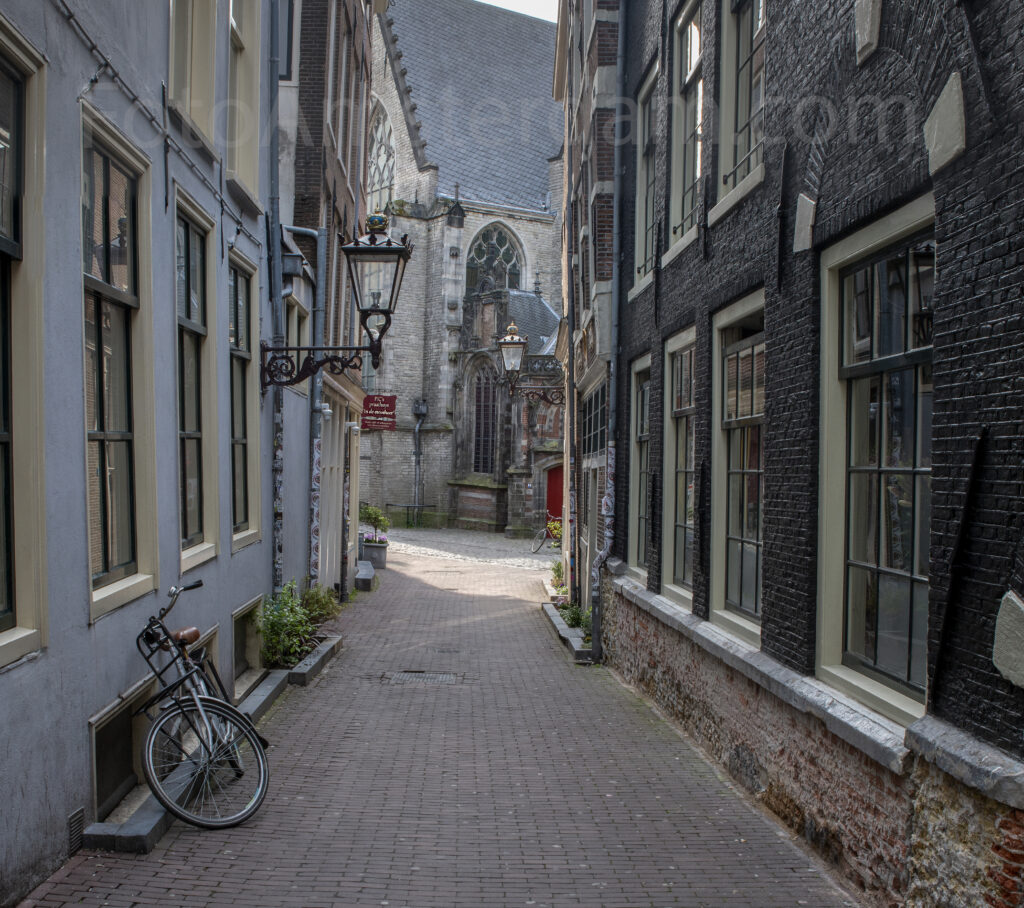
Hidden Alleys of Medieval Amsterdam
Beyond the square, the real character of Old Amsterdam reveals itself in a maze of narrow alleys that have changed little over the centuries. Tiny passages such as the Enge Kerksteeg, Sint Olofspoort and the quiet lanes around the Oudezijds Voorburgwal still follow the medieval street pattern that existed long before the famous canal belt was created.


A Curious Piece of Everyday Amsterdam
Not every historic landmark is grand or monumental. Hidden along the Oudezijds Voorburgwal stands one of Amsterdam’s most unusual monuments to everyday city life: De Krul, the city’s oldest surviving public urinal.
Designed in 1916 by the renowned Amsterdam architect Piet Kramer, the circular brick structure became famous because it allowed men to relieve themselves while remaining largely hidden from view. Its distinctive rounded shape soon earned it the nickname De Krul (“The Curl”).
Although modern public facilities have replaced many similar structures, this remarkable design has been carefully preserved as part of Amsterdam’s cultural heritage. It offers a fascinating glimpse into how practical urban design became part of the city’s architectural identity, proving that even the smallest details can tell a story about Amsterdam’s past.

Beyond famous landmarks such as the Oude Kerk and even hidden curiosities like De Krul, Old Amsterdam continues to reveal itself around every corner. Walking here feels very different from the busy shopping streets only a few minutes away. Historic brick facades, leaning houses, old bridges and quiet canals create intimate scenes that reward those willing to explore on foot. These hidden corners are among my favourite places to photograph because they capture an Amsterdam that many visitors simply walk past.
A View Few Visitors Ever Experience
Few visitors ever have the opportunity to see Old Amsterdam from above. From high above the city, the rooftops of medieval Amsterdam reveal a perspective that few visitors ever experience. Looking towards the Oude Kerk, the dense pattern of canals, narrow streets and centuries-old buildings immediately explains how compact Amsterdam originally was.
Looking across the rooftops towards the Oude Kerk, it becomes clear why this neighbourhood remained the heart of Amsterdam for centuries. The view offers a unique perspective on the city’s earliest history and shows how remarkably well the medieval centre has survived.

WHY OLD AMSTERDAM STILL MATTERS
Old Amsterdam is where the city’s story began. While Amsterdam is famous for its elegant canal belt and vibrant modern neighbourhoods, it is here that the medieval street pattern, centuries-old churches and hidden waterways still reveal the origins of the Dutch capital.
For photographers, history lovers and curious travellers alike, this neighbourhood offers something increasingly rare: the opportunity to slow down and discover a side of Amsterdam that has survived for more than eight hundred years. Around almost every corner, the past is still visible in the architecture, the canals and the intimate streets that continue to define the city’s unique character.
Whether you come to admire the Oude Kerk, wander through hidden alleys or simply enjoy the atmosphere beside the canals, Old Amsterdam remains one of the most authentic places to experience the city.
PHOTOGRAPHY TIPS
Old Amsterdam rewards visitors who explore early in the morning, when the narrow streets are still quiet and the soft light reveals the textures of centuries-old brickwork and historic facades. Spring and autumn often provide the most atmospheric conditions, while black-and-white photography beautifully emphasises the medieval architecture.
Many of the most rewarding photographs are found away from the busiest streets. Take your time, look into the small alleys, follow the canals and don’t be afraid to wander without a fixed route. Some of Amsterdam’s most memorable views are hidden just a few steps away from the crowds.
WHAT TO SEE NEARBY
One of the great advantages of Old Amsterdam is that many of the city’s highlights are within easy walking distance.
- Dam Square & Royal Palace – about 5 minutes
- Nieuwmarkt & De Waag – about 5 minutes
- Amsterdam Central Station – about 10 minutes
- The Red Light District – directly adjacent
- The Canal Belt (UNESCO World Heritage) – about 10 minutes
- The Jordaan – about 15 minutes
After exploring Amsterdam’s medieval heart, it’s easy to continue your walk towards the elegant canals, historic merchant houses and lively neighbourhoods that helped shape the city into the world-famous destination it is today.